Mega is a constellation of tiny public art galleries exhibiting the work of emerging artists. Our mission is to expand access to art beyond institutional walls. We are currently located in Philadelphia.
Currently on View
Brenna Mathers & Rick Morris: Crossing Over
November 16 - January 15
Palumbo Park Gallery
723 Catharine St, Philadelphia, PA 19147
Rittenhouse Gallery
319 S. 16th St., Philadelphia, PA 19102
Death is a fact of every life. Despite its universality, it is difficult to imagine. Its unforgiving erasure of all we know can seem mind-boggling, cruel, and unsettling. Over time, people have managed this unknown with a range of practices. Faith-based rituals, scientific investigation, and tight-lipped avoidance of the topic are just a few. Eventually, each of us must meet death on our own terms.
In service of the exhibition Crossing Over featuring artists Rick Morris and Brenna Mathers, Mega Gallery sought conversations with end-of-life professionals including hospice and funerary care practitioners and chaplains. We heard prescriptions for easing pain, pre-arrangements for easing family burden, and confessions of regret and its release. For most patients and clients, talking about death offered a welcome sense of empowerment. Fear and anxiety often gave way to laughter and warmth. The idea of not living got a little lighter.
Looking at death directly tends to shift perspective. More than seeking an understanding of what does or doesn’t happen after death, many navigating end-of-life begin to pursue presence and clarity within the life that remains before them. End-of-life professionals converged on one common observation: the sooner one builds a healthy relationship with their real and eventual death, the more richly one tends to live. As Martin Heidegger argues in Being and Time, to live authentically, we must acknowledge and turn toward our own death. [1]
Brenna Mathers and Rick Morris are two artists whose practices respectfully nod to death—and then invite it to tea. Coming from different art training, generations, and death ideologies, the artists’ common subject demonstrates the unifying questions surrounding the eventual transition we all face. For Mathers and Morris, considering death is a way of life. Rather than try to decode it, they embrace its mysteries.
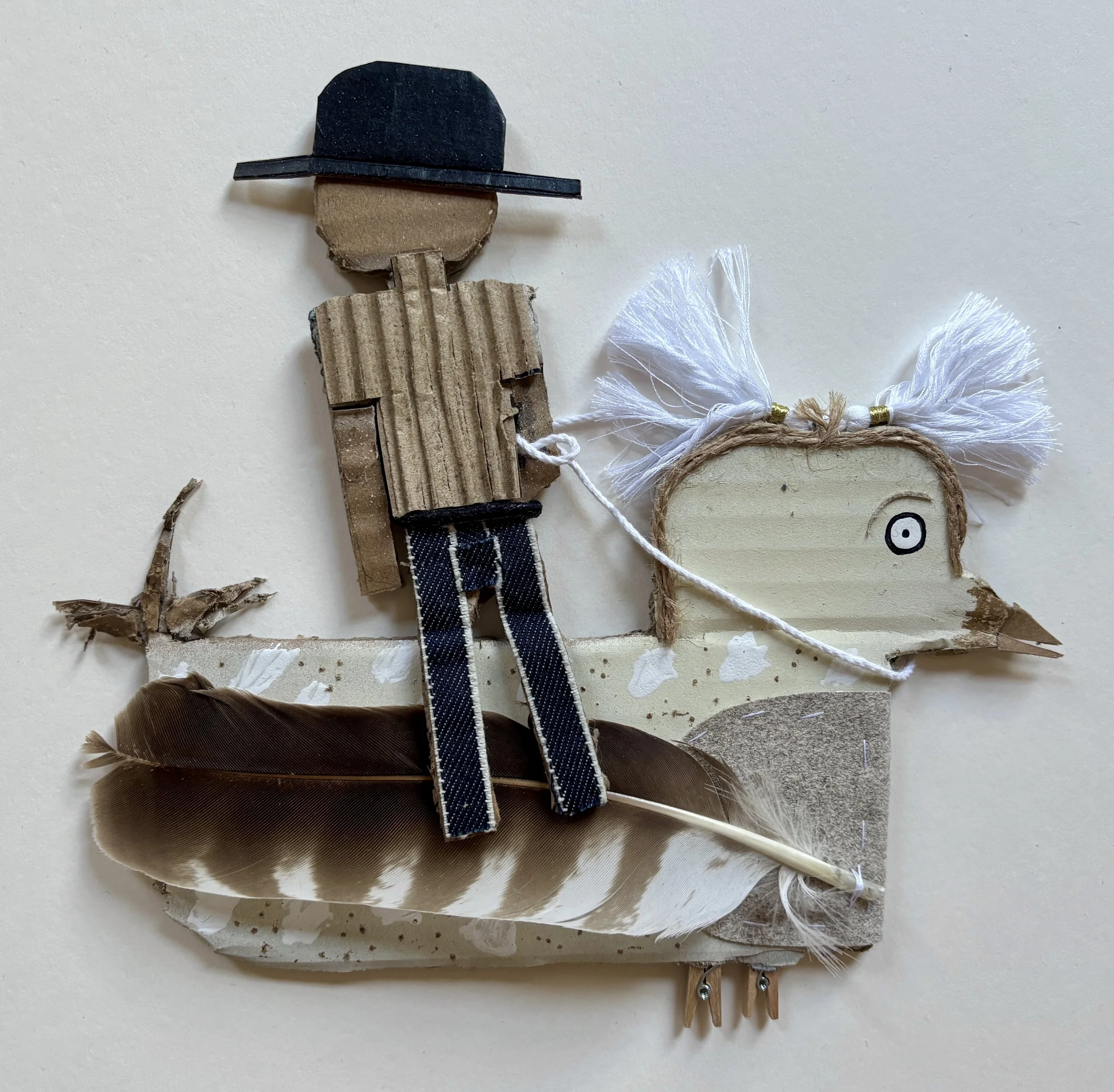
At Mega Gallery’s Palumbo Park location, Crossing Over exhibits pieces from Brenna Mathers’s series of psychopomps: spirits who walk alongside the recently deceased as they transition. Often anthropomorphic beings such as horses, deer, and various birds, psychopamps take many forms. Mathers, a death doula with an integrated mediation and nature practice, regularly watches birds convene at dawn and scatter at dusk, considering how these ancient beings mark fleeting time. She envisions psychopomps in bird form, marking the deceased’s journey to a destination she refers to ambiguously as “the elsewhere.”
Constructed with scraps of cardboard, found feathers, thread, denim, and silk, these off-kilter spirits suggest an alternative transition to the other side, more individualistic and DIY than the Catholic stories she grew up with. One spirit, with pigtails and a giant feather wing, escorts a figure sitting side-saddle; another’s wings open to reveal a shimmering portal at its breast; a third dons silver shoes, leather pants, and supportive silk wings. Each has the same ringed eye, on the lookout for the earthly souls ready to enter the elsewhere. Within her re-assembled everyday materials and punk aesthetic, Mathers reveals a language for her approach to death doula work. She engages with her patients through texture, a playful sense of humor, and familiar resources that exist around them.
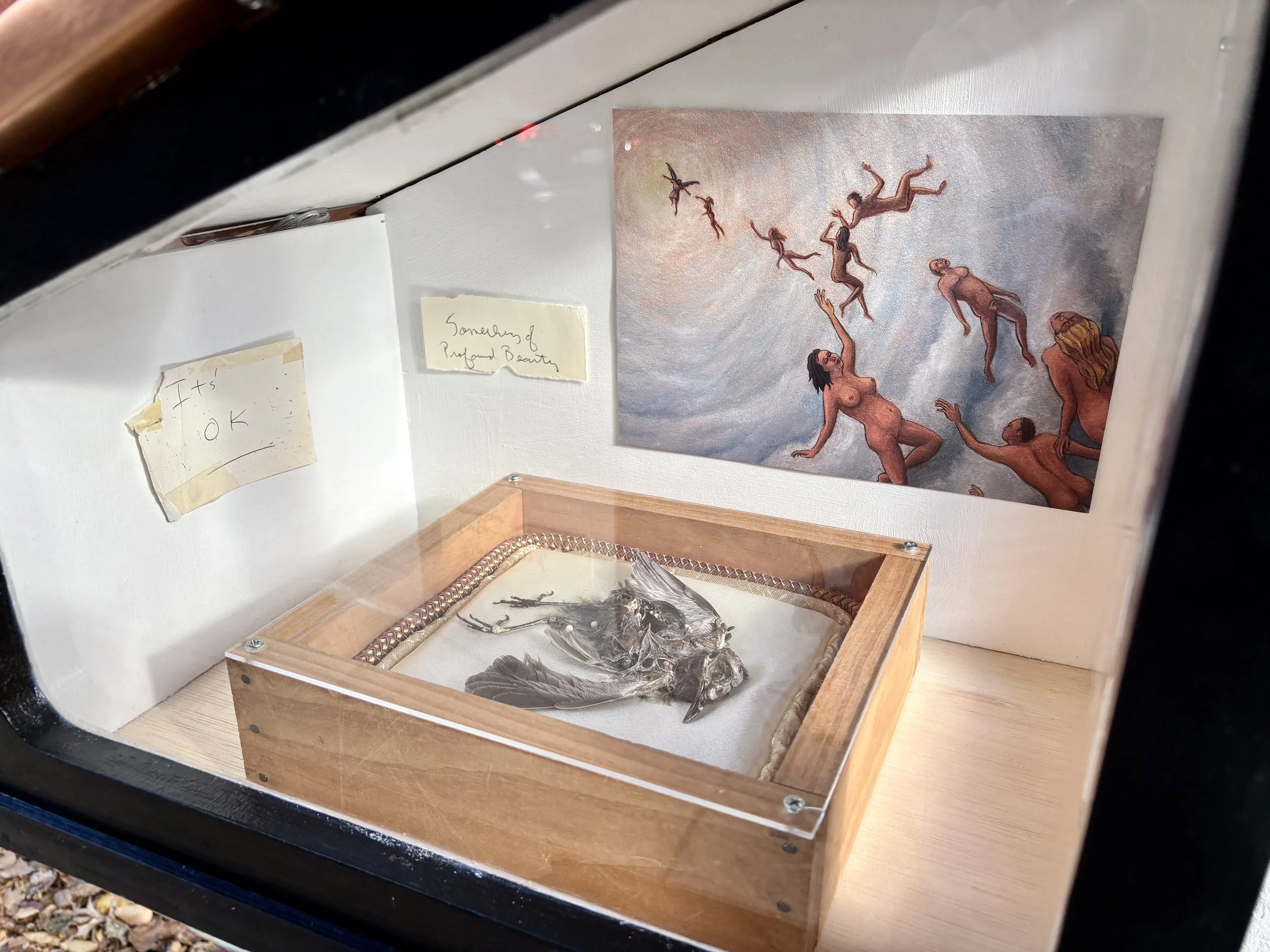
In Mega Gallery’s Rittenhouse location, Crossing Over offers a miniature tour of Rick Morris’s studio, where a lifetime of making reveals a cognizance of mortality and time’s fleeting character. Upon entering the crowded home-studio where he has worked for decades, Morris’s history as an artist is apparent. Racks of past paintings, clearly labeled boxes of supplies, source material, books and CDs stack neatly on studio shelves and under tables. Clippings of artwork and portraits of his favorite artists and thinkers are taped to walls and furniture. Notes with draft titles, reminders, and words to live by—some of which have hung for years—are scrawled on paper and directly on easels. “Not Enough Time,” written decisively in black Sharpie, is especially loud. When Morris talks about his work, he calculates his studio practice against the years he has remaining and measures those years in paintings. It is a wry but serious reckoning with time.
Morris’s beliefs about death and what follows don’t fit neatly into one recognizable ideology, and his studio is proof of that. Jesus Christ is collaged to look reverently at The Buddha; an image of a skull hangs, serving as a memento mori; in an art piece titled Bird, the fragile, slowly decomposing body of a deceased bird rests on a simple satin cushion assembled by the artist. Religions mix and hierarchies dissolve as Morris combines death beliefs to form his own unique vision of the dimension after this one and how we might arrive there. Crossing Over features a detail from Dreams (Into the Light, Gates of Hell), a Christian-inspired diptych about humans’ final stop. In Into the Light, naked bodies float upward, reaching out to an angel who greets them. Their faces express a mix of awe and fear. It can be comforting to picture death in a familiar form. Here, Morris depicts an anticipatory heavenly ascent. Displayed with Bird and notes that read “Something of Profound Beauty” and “It’s OK,” Morris’s work makes no direct claim but invites acceptance of the transition that awaits us all. ∎
-Robin Morris, Curator
[1] Heidegger, Martin. Being and Time. Translated by John Macquarrie and Edward Robinson. New York: Harper & Row, 1962.
Brenna Mathers
Brenna Mathers is a death doula and artist, raised in Pittsburgh and now in Miami. She draws on the land, the sky, and the folk art of Mamie Deschillie (Diné, 1920–2010), and believes curiosity is a better companion to life and death than dread. Find her at brennamathers.com.
Rick Morris
Rick Morris is an artist with deep roots in West Virginia and Maryland. His business card reads “Old Man Painting.” Find Morris and his work at rickmorrisart.com.
Adriana Del Río Figueroa: preciosa
October 12 - November 30
North Gallery
2001 N. 13th St., Philadelphia, PA 19122
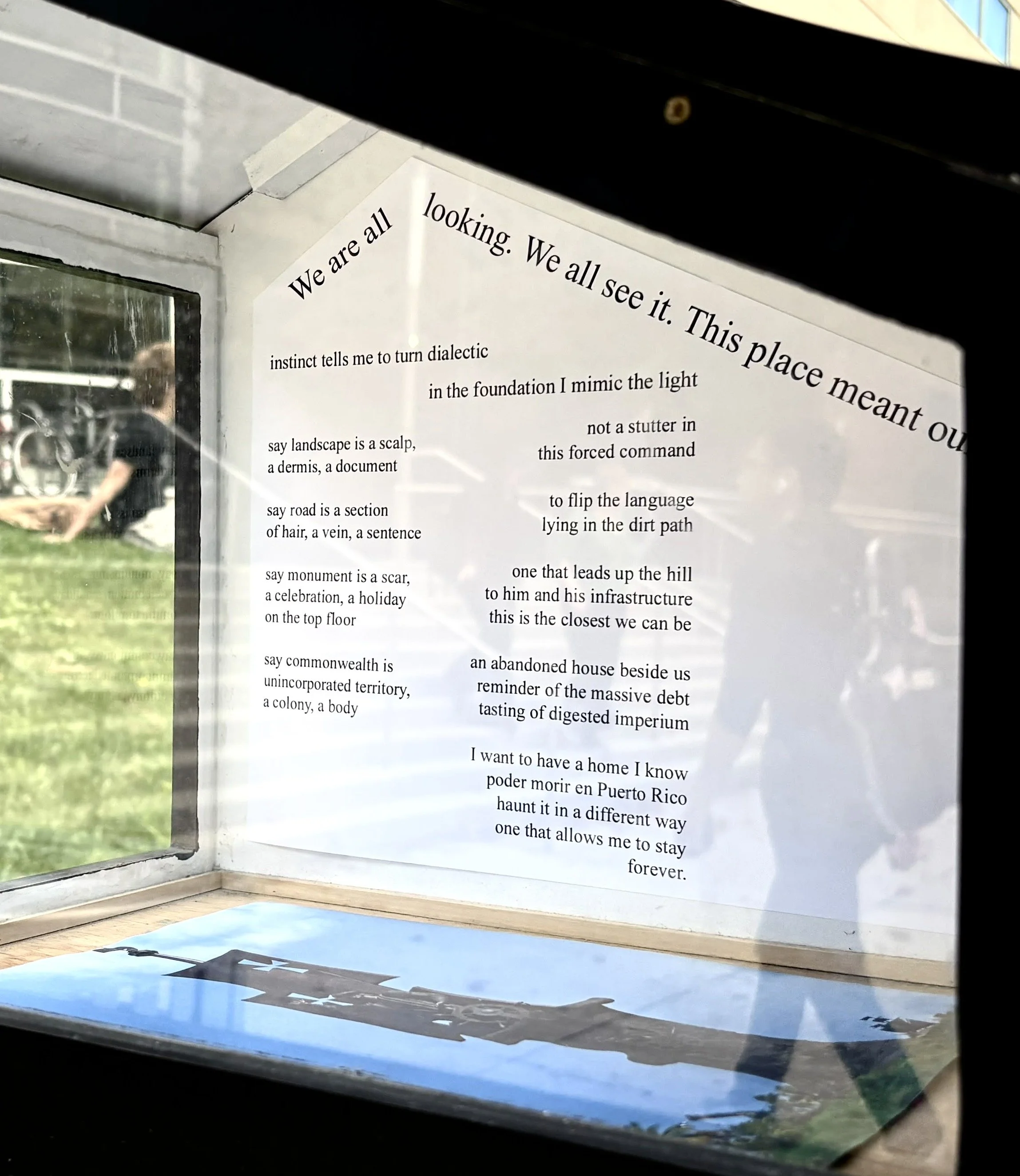
The largest statue in the Western Hemisphere is a monument to Christopher Columbus, rising 361 feet above the north shore of Puerto Rico. Titled Birth of the New World, this statue serves as the jumping off point for Adriana Del Río Figueroa’s exploration of Puerto Rican identity amid ongoing colonization in her poem, “preciosa.” Taking its name from the 1937 Rafael Hernández Marín song, an unofficial anthem of Puerto Rico, “preciosa” details the historical and ongoing colonial violence against the island, mirroring this to the violence against both the Indigenous and non-Indigenous people who call it home.
In this display, the text of “preciosa” and the natural landscape of the Caguas Valley tower over Birth of the New World, which has been stripped of its height and power. As many continue to celebrate holidays like Columbus Day and Thanksgiving, “preciosa” reminds us that these colonial moments do not exist solely in the past but continue to dictate the lived experience of real people in the present, especially on lands that still do not have full self-determination. ∎
-Béatrice Duchastel de Montrouge, Curator
Adriana Del Río Figueroa
Philly-based poet Adriana Del Río Figueroa was born and raised half in Puerto Rico and half in Tampa, Florida. Recently graduated from the MFA program at Temple University, Del Río Figueroa writes within a legacy of Caribbean diaspora poets who seek to trace the imperial threads that often sew together the colonized body and mind.
Past Exhibitions
Olivia Smith: Women’s Work
Summer 2026
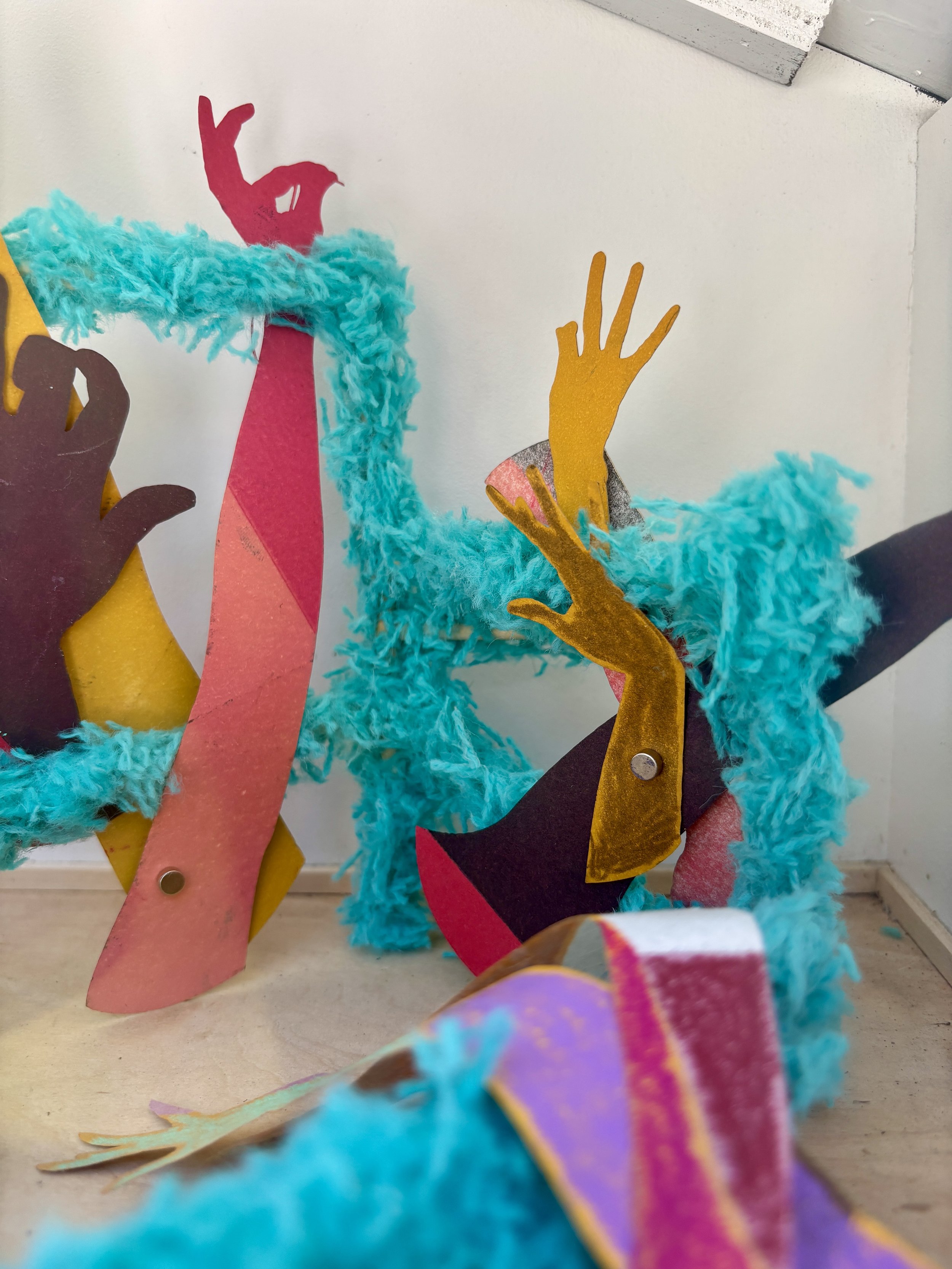
Reaching, fluttering, straining, stretching arms, hands, and fingers fill the gallery this summer in Olivia Smith’s Women’s Work. Pink, purple, and yellow expenditures weave through an architectural grid made of wooden dow rods whose right angles have been softened by bits of furry aqua yarn. Against these feathered beams, the crisp edges of silhouetted limbs—which Smith has delicately cut from paper—move with nimble intention. The relationship between these limbs and their architectural environment is curious. No doubt the hands work vigorously, but it is difficult to discern if they work in, out, around, in spite of, or in production of the blue fiber structure itself.
This concern touches upon the core of Smith’s practice. While society’s patriarchal architecture instructs women to keep up appearances of elegance and ease, behind the scenes, women labor tirelessly. Smith uses hands to depict the underacknowledged physical and mental labor women perform to maintain and nurture their communities and the lives of loved ones (and, if they are lucky enough to have the time, their own lives). However, there is also beauty and gratification in this care. Despite its difficulty, women make the choice to balance travail, creativity, and weariness with grace. Maneuvering within society’s restrictive systems, women’s labor quietly transforms systems themselves. Like Smith’s tedious application of soft aqua yarn, the unseen work of women invites softness and joy, creativity and cherishment, into our world’s hard-edged structures.
The hands in Women’s Work belong to Smith. She traces her poses from silhouetted light projections, embracing her body’s different shapes: from delightful dance-like expressions, to language-like signs, to stiff clenching brought on by taxation. In this exhibition, we witness the joys and frustrations of the labor of one as, in her own words, Smith, like so many women, “can’t seem to take a break.” Women’s Work operates as a call to ease this burden and help each other—to first recognize, appreciate, and perhaps even lighten the load of the women workers who are so vital to our communities. ∎
-Robin Morris, Curator
Leia Fifer: Meat Creature
May 2 - June 1, 2026
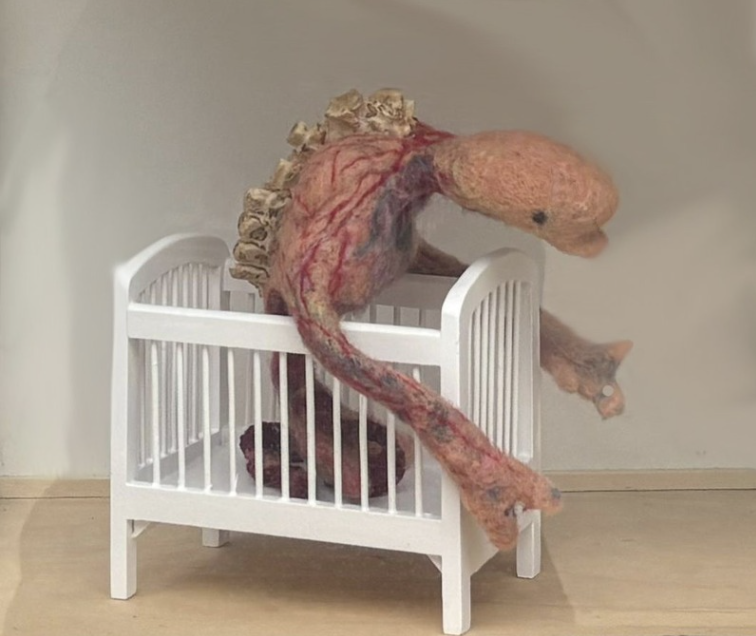
Living in a body is a fact of life. But often, living in a body can be a horror, especially when that body does not meet normative expectations. Being genderfluid and disabled (including living with Tethered Cord Syndrome, among other neurological and chronic illnesses), themes of being trapped in the body by pain and physical decay often push to the forefront of Leia Fifer’s work. Meat Creature is a result of this pain, a true horror for many, but approached with wit and a touch of humor. The sharp, bony spine contrasts with the soft wool of its small body, reminiscent of the baby from David Lynch’s Eraserhead. Carefully held within a crib, Meat Creature is also a result of love, seeking to create companionship and connection amidst this suffering. Evoking mixed emotions—disgust, empathy, anxiety, amusement—Fifer’s work aims to share the complex bodily and resulting psychological experiences of being human. ∎
-Béatrice Duchastel de Montrouge, Guest Curator
Leia Fifer
Leia Fifer is an interdisciplinary studio artist from Woonsocket, Rhode Island, blending process-driven mediums into work that functions as a tool for connection and liberation. Their work has been shown in Rhode Island, Massachusetts in curated shows at the Warwick Center for the Arts, won honorable mentions at the Providence Art Club, and has appeared in group showings through independent and DIY venues. Fifer is a Community College of Rhodes Island Alumni, graduating in 2025 with an Associate’s in Fine Art. They are currently a member of the Providence WaterFire Art Center’s Accelerate 2026 cohort.
Priya Vaswani: Image and Index Iteration
April 10 - May 1, 2026
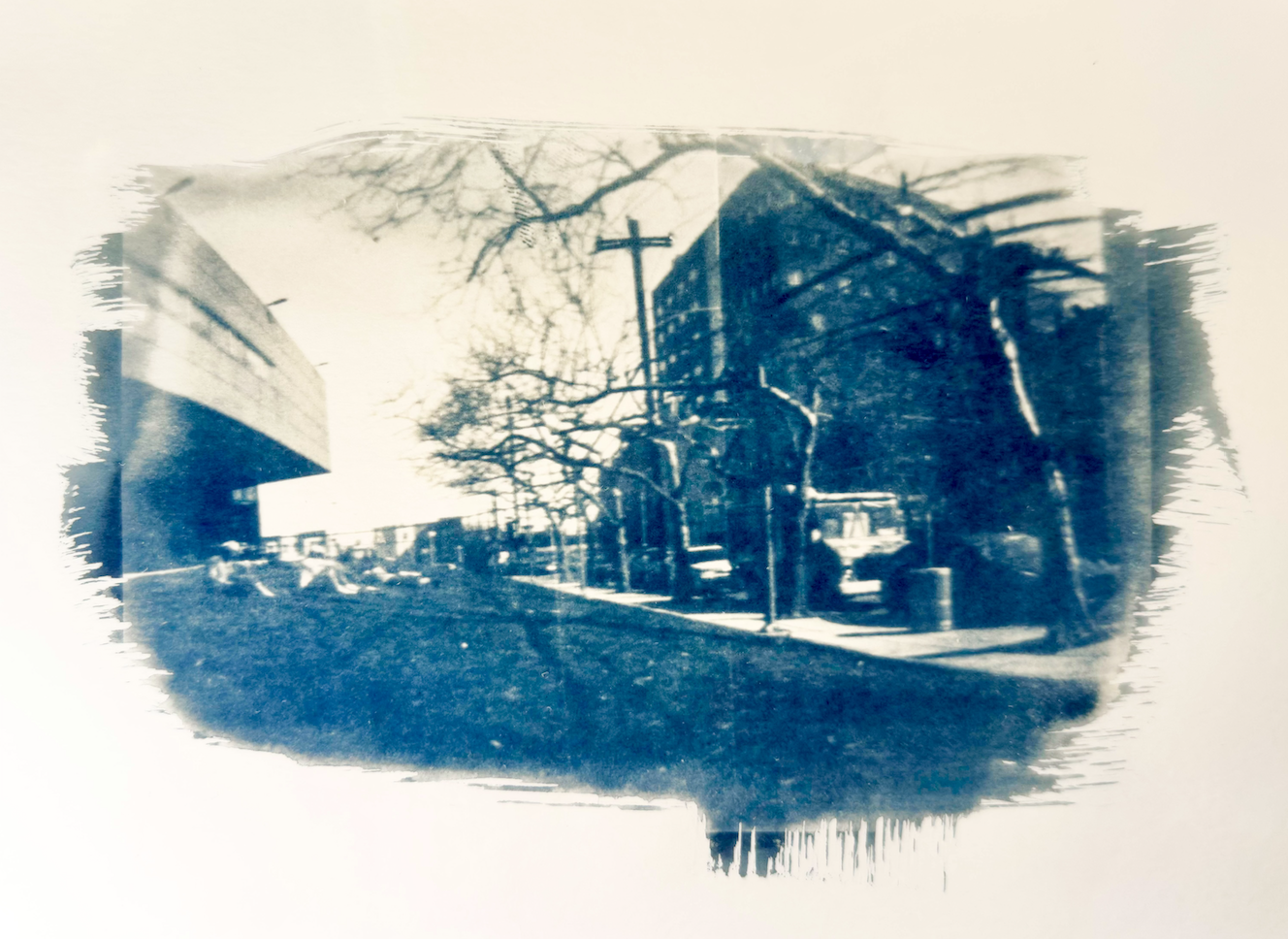
The images presented in the second iteration of Image and Index emphasize process—in this case, a fully analog chain of light-based translation resulting in cyanotype contact prints.
Here’s how it works: in the initial exposure, light passes through a pinhole camera, inscribing a latent image onto film. That film negative is then placed in direct contact with cyanotype-coated paper and exposed to ultraviolet light, which passes through the recorded image.
This contact process materially reactivates the original capture, as the same environmental force—light—first records the spatial field onto film and then produces the image onto paper. The resulting cyanotype prints carry a doubled index, holding the trace of the original moment alongside the conditions of their making. ∎
-Michael Vasquez, Guest Curator
Priya Vaswani: Image and Index
March 10 - April 9, 2026
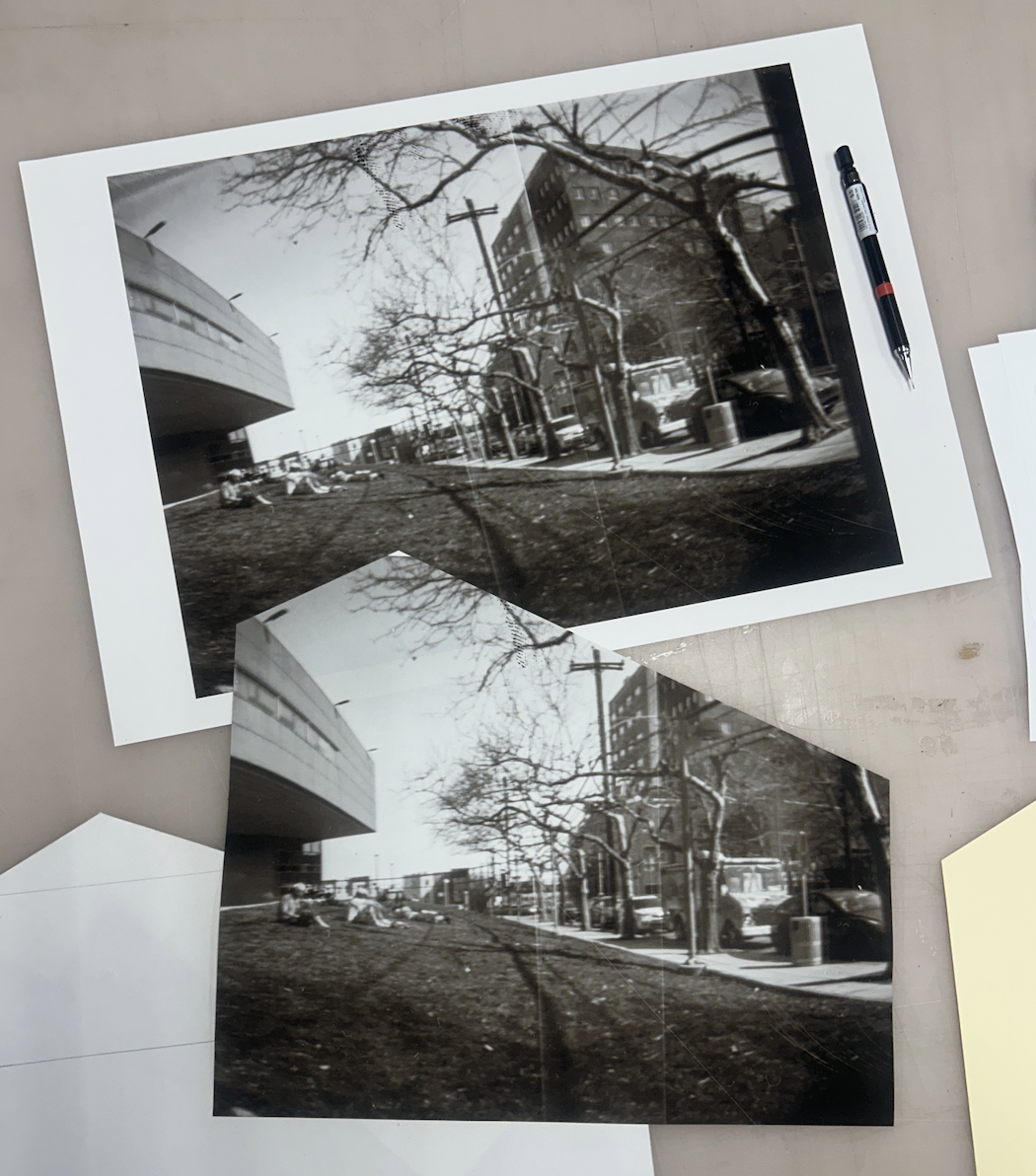
Image and Index explores photography as both a visual representation (image) and evidence (index) of a specific place and moment near Mega Gallery. Using pinhole photography, Vaswani and Vasquez worked together to capture two exposures—one for each wall of the gallery structure—taken from the precise vantage point where the prints were later installed. When mounted in the space, the images create the illusion that the walls have become transparent, as if the viewer is looking directly through the gallery into the surrounding environment.
Because the images record the light conditions at a particular time and location, the installation functions as a highly site-specific gesture. The photographs do not simply represent the space—they preserve a trace of the light that once passed through it. In this way, the work situates photography as a temporal record, holding a past moment in tension with the viewer’s present experience of the site.
Impermanence and experimentation sit at the fore of this Image and Index as curator and artist plan future iterations in response to viewer inquiries. Stay tuned for their upcoming installation that will address curiosities about process. This second iteration aims to emphasize the exhibition’s various stages and tools including pinhole camera and original film negatives, offering a transparent look at image and index-making. The current prints are inkjet reproductions on matte paper and serve as a provisional stage in an evolving investigation of photography, site, and time. ∎
-Michael Vasquez, Guest Curator
Michael Vasquez
Michael Vasquez (also known as “vasqmic”) is a Philadelphia-based graphic designer and printmaker from the Central Coast via Portland, OR. His artmaking practice privileges stewardship over authorship, foregrounding the production of ephemeral materials intended for handling and circulation—some lend themselves to quiet reflection (as in the light-sensitive processes he reserves for sentimental images), while others operate as a rallying call within community gatherings (such as protest posters reproduced in large quantities). It is these caretaking and collaborative dimensions within Vasquez’s practice that drew us to his work, prompting an invitation for him to curate our space.
Laura Sallade: Slow Read
Feb 3 - March 10, 2026
In a world increasingly mediated by digital technology—where speed and the-need-to-know reign—glass and light serve as invisible backbones. Hair-thin strands of fiber optic glass transmit massive data volumes as light pulses. Communication is compressed and delivered through a screen, collapsing distances that once took months to traverse and marginalizing the embodied experience. Trained in speedy intake, we have lost our ability to look slowly. Spoiled by instantaneity, mystery no longer whets the appetite.
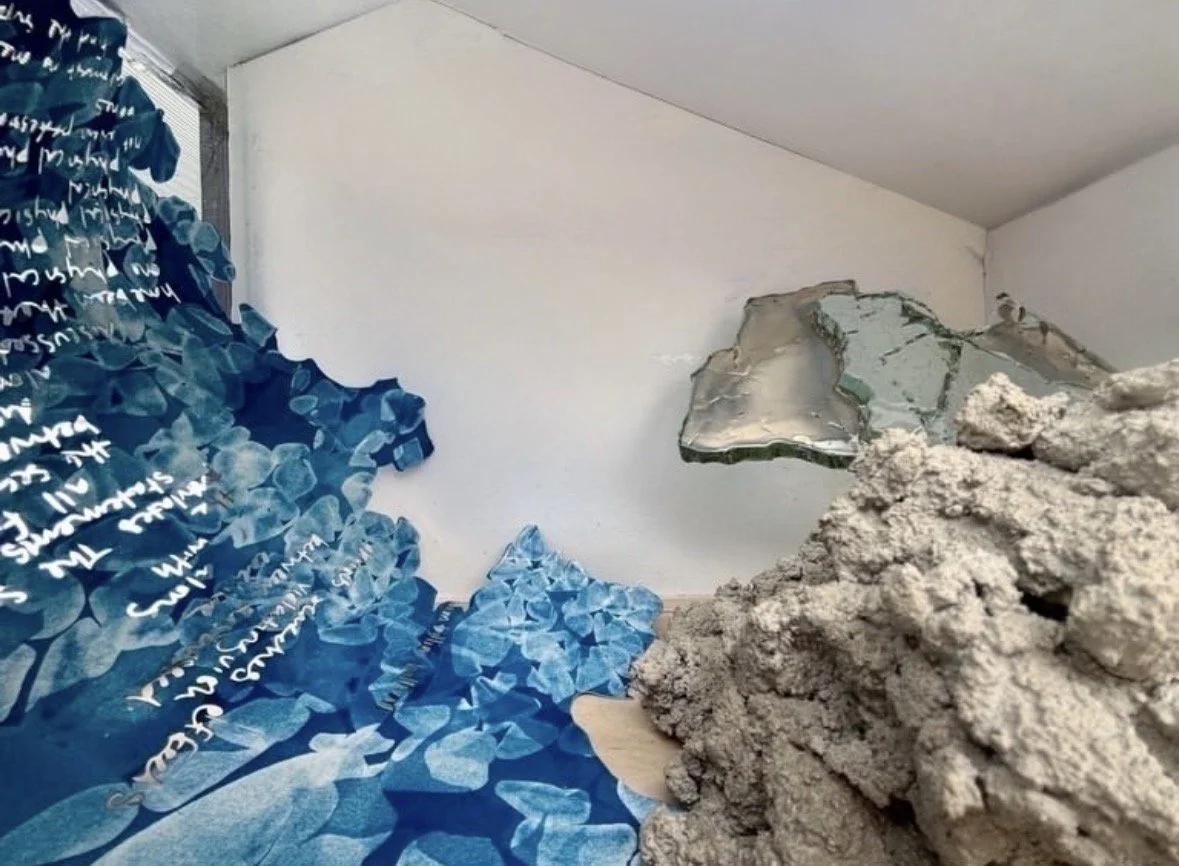
Departing from the screen and looking to the genealogy of glass, Laura Sallade aims to return a sense of wonder to the material. Or, conversely, through glass and light, Sallade resurrects the sublime within the human experience. Glass has been forming naturally since the beginning of geological time and, in its brief history with humans, it has been revered for its ability to pass light, change states, and mold into new forms. [1] Colored, matte, transparent, tempered—glass has been used in beakers, lenses, architecture, and jewelry. Before the emergence of microscopic technology, glass presented as a material reality—encountering it was tangible yet mysterious. Its ability to refract, reflect, and collaborate with light infused small tokens with perceived vitality and granted architectural works the power to shape vast surrounding space.
Sallade’s work embraces glass in various states, creating a viewing experience through which one begins to grasp the material’s rich lineage. In Slow Read, shimmering pieces with oozing, iridescent surfaces slice into concrete, a material with shared origins in sand. The narrative weight of glass is further called forth by the exhibition’s work on paper. A glacial blue page filled with delicate script letters leans against the galley wall, reminiscent of a pre-digital time where stories were written by hand.
While material ecology and history draw connections between paper and glass, the seemingly disparate materials are further bound by light. Rather than resting on the surface, Sallade’s words are delicately cut into the cyanotype-stained paper, forming clefts that invite illumination. One strives to take the page line by line as sunlight flickers through script letters, refracts off glass, and dances across gallery walls.
Here, the importance of the script yields to watching light and glass perform their quiet magic. Slow looking reveals the pleasures of captivation—for in an effort to read words, one begins to read light. Sallade writes of her work, “I rely on light and glass to articulate the ineffable.” In Slow Read, where her chosen materials encounter the written word directly, Sallade’s desire for marvel to prevail is made explicit. ∎
-Robin Morris, Curator
[1] While humans developed glass as a technology as early as 3500 BCE, it is only in the last century that glass permeated the modern world.
Henry Rosenberg: The Narrator
Nov 24 - Dec 29, 2025
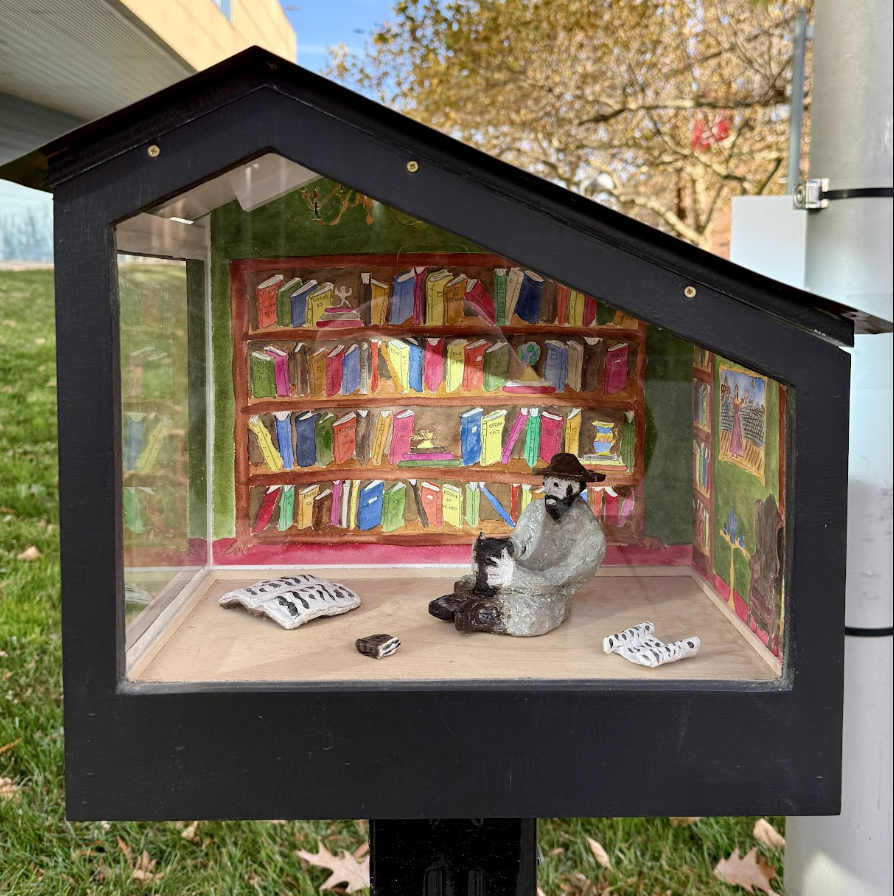
Henry Rosenberg’s The Narrator is a room for story sharing. The exhibition recalls the stage, complete with props, scenery, and a main character. Books and art objects line the walls. A large painting depicting the famous opera La Tosca hangs above a handsome armchair where a reader might contemplate Theology or Psychology of Human Behavior—titles that fill the room’s bookshelves. Between texts that tackle the humanities, we spot a globe, a vase, and a small marble statue of a Roman wrestler, artifacts that suggest collecting and knowledge of far-away worlds. On the floor, center stage, Rosenberg’s clay narrator sits surrounded by books and an unrolled scroll. He sports a healthy beard and wide-brimmed hat, reminiscent of a 19th-century travel writer. With a chandelier overhead and book jackets whose bright colors have worn soft over time, the narrator’s room has a cozy glow, one that invites tweed jackets with elbow patches and the romanticization of a PhD journey.
Rosenberg likes the idea of “cozy” and how it is evoked with images of yesteryear. A big fan (and admitted novice) of opera and an artist trained in centuries-old printing press processes, these art traditions permeate his work. The opera’s red velvet curtain that announces each grand performance is echoed in the library’s red rug on which bookshelves stand tall, displaying books titled Rembrandt and Old Masters. However, Rosenberg recognizes that when you interrogate the pleasantries of these historic spaces, they are only comfortable for a privileged few. In the case of his model antique library, Henry asks, “What texts are present? What are they really about?” and “Who do they serve?”
Historically, the printed word was seen as “the truth.” A signifier of education and power, books simply stated “the way things were”—uncontestable and accurate. With his focus on the narrator, Rosenberg aims to dismantle the idea of print as veracity. The narrator is a performer, someone who takes the printed word and transforms it beyond the book. In doing so, he gifts these histories different perspectives. As print becomes performed, stories are passed to new audiences. Like a game of broken telephone, the story morphs—each narrator playing their hand in its remaking. The once-omniscient printed word enters casual storytelling with egalitarian potential.
The Narrator has collaborated with The Little Free Library, inviting exhibition viewers to assume the role of storyteller. Curated in response to the titles in Rosenberg’s drawings, the public library acts as a continuation of the story. With classic tales, historical accounts, and childhood favorites, Rosenberg and his clay narrator hope you join them. Won’t you take a seat, have a read, share with a friend, and help build a beautiful story? ∎
-Robin Morris, Curator
Madeline Rose Guido & Quincy Adrien Hukow: Sketch Book Body
Nov 7 - Nov 23, 2025
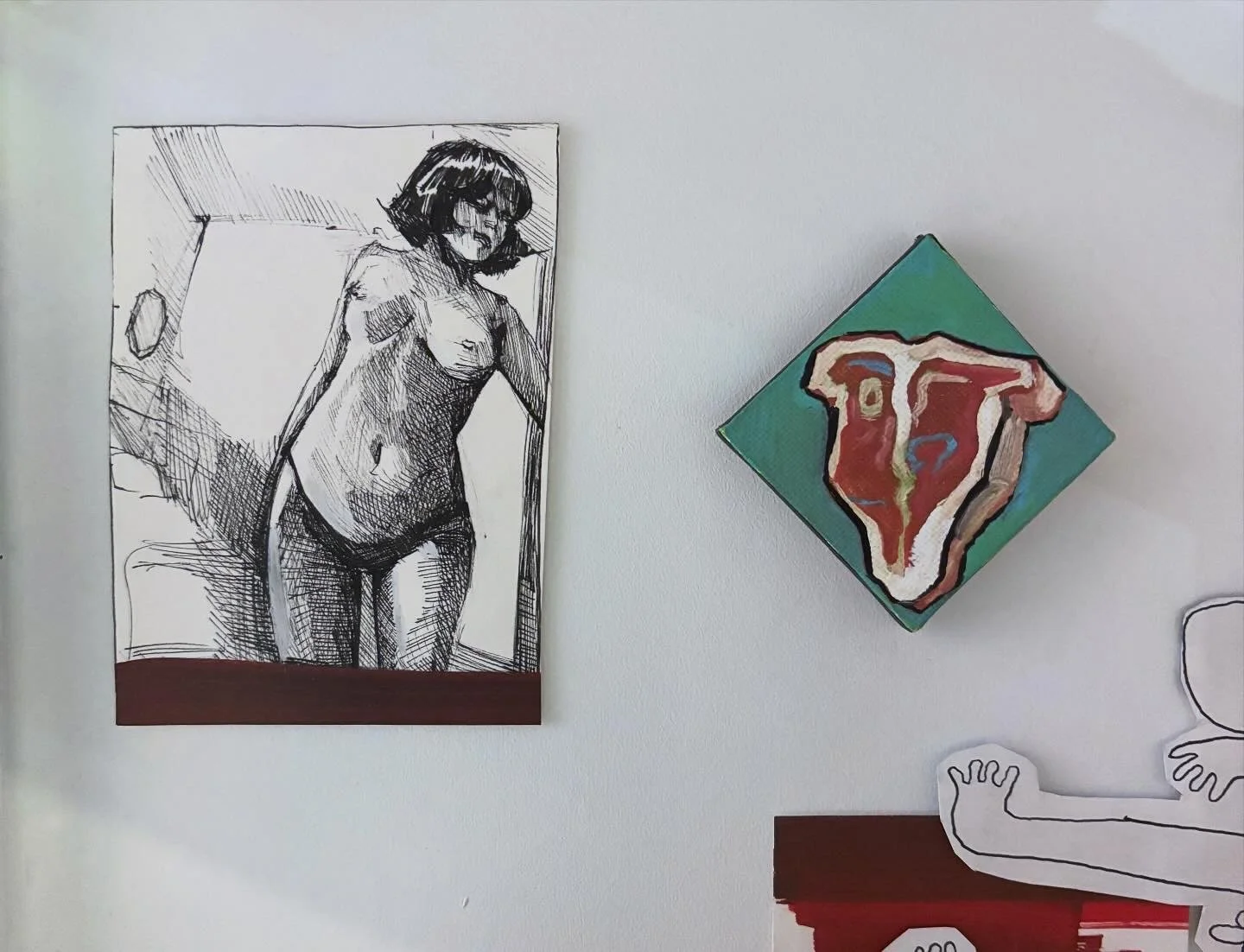
Artists Madeline Rose Guido and Quincy Adrien Hukow have teamed up for Sketch Book Body. This exhibition features a peak at the painters’ preliminary drawings and their explorations of the figure, early in their process.
Guido is a figurative artist whose oil paintings engage with remembrances and social environments. Hukow’s work centers on queer themes, bodies, meat, and humor. In Sketch Book Body, Hukow’s stickering effects converse with Guido’s atmospheric spaces to probe both the surface layer and underlying psychological current embodied in the figure. This short show serves as a preview for a future collaboration. ∎
-Robin Morris, Curator
Parsa Ferdowsi: Poem-Scores
Aug 22 - Sept 25, 2025
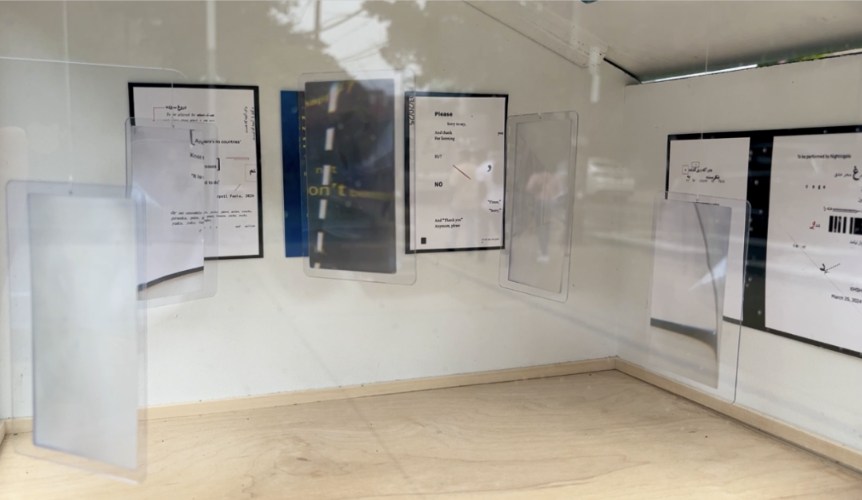
Parsa Ferdowsi’s exhibition Poem-Scores is a sample collection of pieces composed in 2024 during the Nowruz holidays, the Persian new year.* Inspired by everyday thoughts and conversations, Persian poetry (poets Saadi Shirazi and Bijan Elahi), and event scores composed by Fluxus artists (Ken Friedman’s “99 Events” and Yoko Ono’s “Grapefruit”). Ferdowsi draws on his work as a musician and composer to create his “poem-scores”. With this intentional name, Ferdowsi plays with the expectations often associated with the two art forms, and the difference in how each is realized. A poem is read; a (music) score is performed. The visual qualities of his poem-scores emerge from a desire to inject the performativity of a score into the symbolic world of a poem. In the works’ titles, Ferdowsi calls for the performance of the piece—in the tradition of music scores—but with unconventional performers (Pain and Nightingale, for example).
English and Farsi are accompanied by elements of a strictly visual language—razor thin lines slice through words, brackets and boxes enclose symbols. Some sit tensely close, yet do not touch; others sit far apart, a forced rest in the reading. And, while some marks appear purposeful, others seem like arbitrary additions—diagonal lines that fell at random like in a game of Pick Up Sticks. This begs the question, how much of the composition is a clever construction by Ferdowsi and how much does he, like (John) Cage who is referenced in “To be performed by Nightingale,” relinquish control to chance?
For Ferdowsi, it isn’t a question of all or nothing—he prefers ambiguity and welcomes the manifold. A musician whose performances privilege improvisation, he sees his work as a collaboration between himself, the viewer/listener, and the space in which the work resides. Nothing is static—a belief system that is further illustrated with magnifying lenses that float before the work. Unfixed, they both clarify and obscure the printed piece. We read Ferdowsi’s compositions by oscillating between magnified glimpses and the squinting naked eye, creating a viewing experience that is never straight forward, quietly mysterious, and gifts intermittent revelations. ∎
-Robin Morris, Curator
Parsa Ferdowsi
Parsa Ferdowsi is currently studying Music Technology in Temple University’s graduate program. He holds an M.A. in Experimental Music/Performance from Wesleyan University and a B.A. in Composition from the Tehran University of Art. He has years of experience studying santur and Radif, a traditional Iranian music. His most recent composition “something missing” can be found on Bandcamp.
Ferdowsi will be performing with his group, Shiraz Ensemble, as part of Philadelphia Fringe Festival. Performances will be hosted by Icebox Project Space Gallery on September 5, 11, and 24.
Silas Holbrook: Presence/Absence
June 9 - July 31, 2025
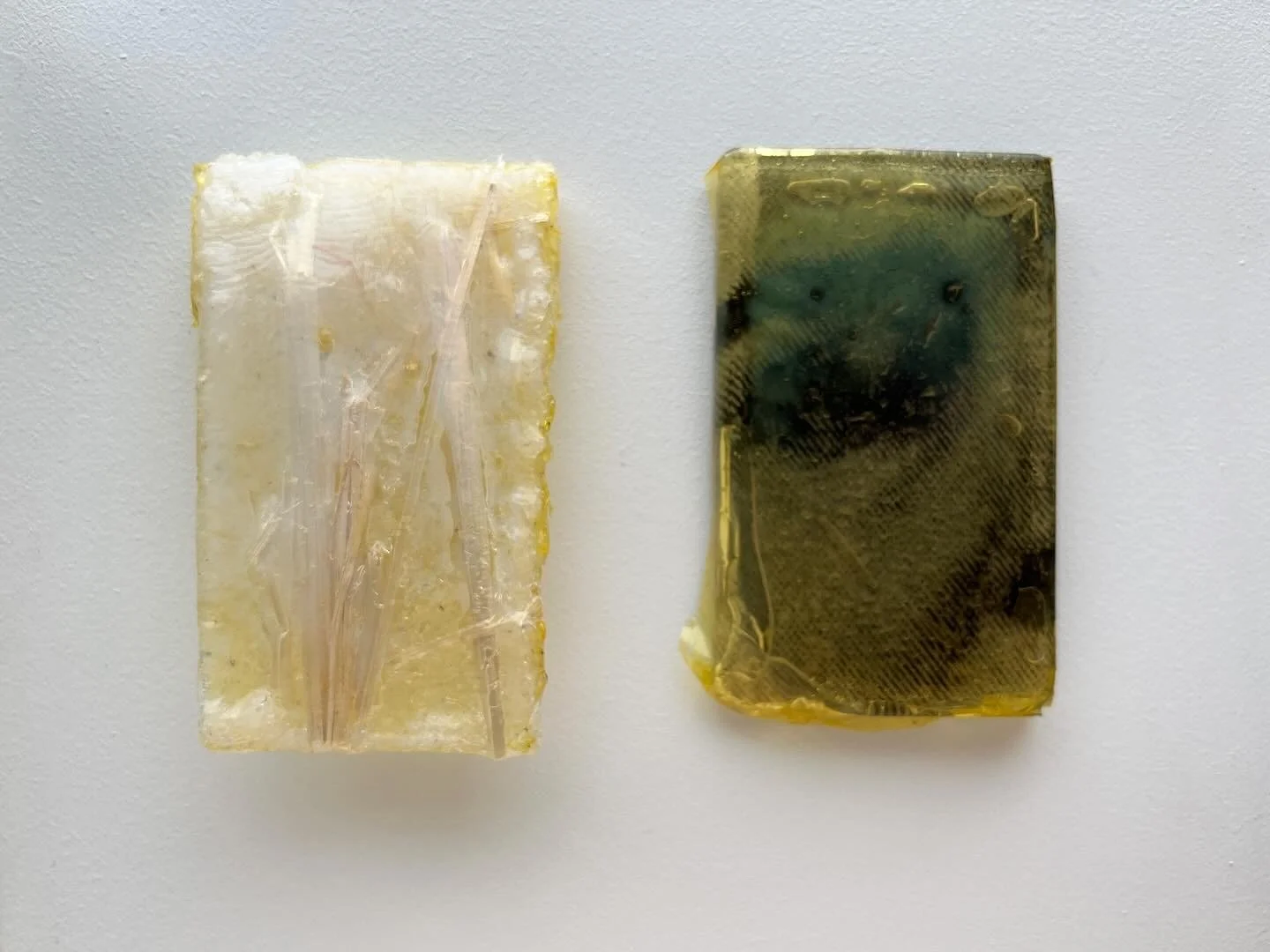
Silas Holbrook’s fleshy “packages” wrap and reveal layers of straw, glass, and difficult-to-identify textures and imagery. Materiality sits at the core of the viewing encounter.
Holbrook’s work serves as a picto-language—a means of expressing a human relational experience while circumventing words and naming. Through materials that mold and stretch, such as acrylic pouring medium and resin, Holbrook both processes and encases a human dynamic. The organic mediums recall the phenomenological lived experience—both of Holbrook’s making process and of the experience to which they refer.
However, this act of “packaging” is not for purposes of shelving and storing. Instead, the translucent layers keep the experience ever-present, yet obscured, creating a sense of indirectness with the inner contents. Like a memory belonging to the past that remains just out of reach, the work evokes mixed feelings of alienation and visceral presence.. ∎
-Robin Morris, Curator